
Manufacturing & Automation IP Attorney

Who Owns Your Automation Technology? Protecting Sensors, Control Systems, and Process Know-How
We often receive a call after something has already gone wrong. A controls engineer leaves for a competitor and takes twelve years of data and process knowledge with him. An integrator finishes a line and refuses to hand over the source code. A vendor who went through a plant tour shows up eighteen months later with a suspiciously familiar product. By the time the question gets asked out loud, the honest answer is often that nobody knows who owns what.
Industrial automation and sensor technology rarely fit neatly within a single form of intellectual property protection. The value is spread across different hardware, embedded firmware, control logic, calibration data, and the accumulated process knowledge that never gets written down. Some of it is patentable. Some of it should never be patented. Almost all of it is created by a mix of employees, contract engineers, integrators, and outside vendors, which means deteremining ownership rights is rarely as clean as anyone likes.
The Intellectual Property Center works with manufacturers, machine builders, sensor developers, controls firms, and industrial technology companies to sort that out before it becomes a dispute. We are a Kansas City intellectual property law firm with more than twenty years of practice and over 400 U.S. patents prepared, and we handle automation matters the way engineers actually build systems: hardware, software, data, and people, all at once.
The Intellectual Property Hiding Inside Your Automation Stack
Most automation companies dramatically underestimate how much protectable intellectual property they own, because the valuable parts do not look like inventions. They look like normal engineering work.
Sensors and Sensing Hardware
Novel transducer designs, packaging that survives a specific environment, signal conditioning circuits, sensor fusion arrangements, and mounting or housing configurations are all candidates for patent protection. The physical arrangement of a sensor assembly may also qualify for a design patent if its appearance is distinctive and non-functional.
Controllers, PLCs, and Control Architecture
The control architecture itself is often the real invention. How a controller sequences operations, handles fault conditions, coordinates multiple axes, or distributes decision-making between edge devices and a central system can be claimed as a method or a system, even when the underlying hardware is off the shelf.
Monitoring, Diagnostics, and Predictive Systems
Condition monitoring, predictive maintenance algorithms, anomaly detection, and quality inspection systems are among the most commercially valuable automation technologies today. They also tend to be the most vulnerable, because they are usually delivered as software and demonstrated to prospects long before anyone files anything.
Automation Methods and Process Steps
A method of controlling a process, of calibrating a machine in the field, of compensating for drift, or of automatically adjusting parameters based on measured conditions can be protected as a method claim in a utility patent. Method claims are frequently the strongest asset an automation company holds, and the most commonly overlooked.
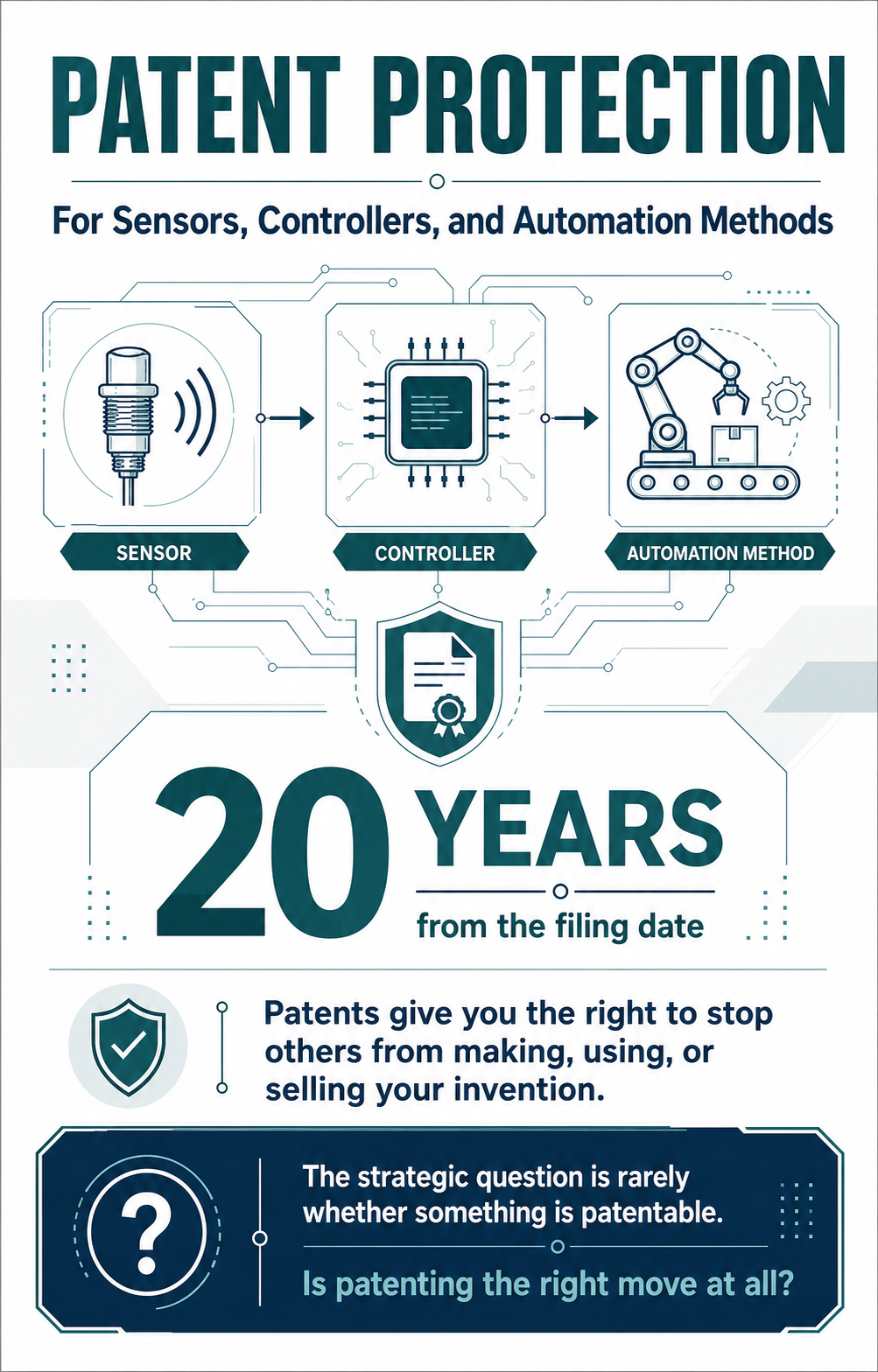
Patent Protection for Sensors, Controllers, and Automation Methods
Patents give you the right to stop others from making, using, or selling your invention for twenty years from the filing date. For automation technology, the strategic question is rarely whether something is patentable. It is whether patenting is the right move at all.
What to Patent and What to Keep Quiet
Patent it when the invention will be visible in the field. If a competitor can buy your sensor, open the housing, and see how it works, a patent is the only thing standing between you and a copy. Hardware, mechanical arrangements, and anything reverse engineerable belongs in a patent application.
Keep it quiet when the invention is invisible in operation. Control logic running inside a sealed cabinet, a calibration routine, or a set of process parameters may never be discoverable by a customer or competitor. Publishing that in a patent application, which becomes public eighteen months after filing, can hand away the exact thing that made you competitive.
We help clients run this analysis invention by invention rather than applying one policy to an entire portfolio. A professional patent search early in the process tells you whether the space is already crowded and whether the filing is worth the investment.
The Filing Deadline Manufacturers Miss Most Often
Under U.S. law, an inventor generally has one year from the first public use, offer for sale, or public disclosure of an invention to file a patent application. Miss that window and the right is gone permanently. Most other countries are stricter still and require absolute novelty, meaning any public disclosure before filing can destroy foreign rights entirely.
For automation companies, that clock starts in places that do not feel like public disclosures at all. A trade show demonstration. A quote sent to a prospect that describes the technical approach. A pilot installation at a customer plant. A conference presentation by an engineer who was proud of the work. A provisional patent application is often the practical answer here, because it establishes a priority date quickly and at lower cost while you decide whether to pursue full protection.
Trade Secret Protection for Calibration Data, Control Logic, and Process Parameters
Trade secret law protects information that derives independent economic value from not being generally known, provided you take reasonable measures to keep it secret. For automation and manufacturing, this is frequently the more valuable body of protection, and it lasts indefinitely as long as secrecy holds.
What Usually Qualifies
Calibration curves and sensor compensation data developed over years of testing. Control logic, tuning parameters, PID setpoints, and recipe libraries. Manufacturing methods, tooling approaches, and fixture designs. Process parameters such as temperatures, feed rates, dwell times, and pressures that were arrived at through expensive trial and error. Yield data, failure analysis, and the internal knowledge of which approaches did not work, which is often as valuable as knowing which ones did.
Reasonable Measures Are a Legal Requirement, Not a Best Practice
Courts do not protect information you did not protect yourself. Under the federal Defend Trade Secrets Act and state statutes including the Missouri Uniform Trade Secrets Act and the Kansas Uniform Trade Secrets Act, a claim fails if the owner cannot show reasonable efforts to maintain secrecy.
In practice that means identifying and documenting what you consider secret, restricting access on a need to know basis, using confidentiality agreements with employees and third parties, marking sensitive documents and drawings, controlling access to code repositories and controller programs, and running exit interviews that address the return of information. Our trade secret protection practice builds these programs for manufacturers before there is a problem, and enforces them when there is one.
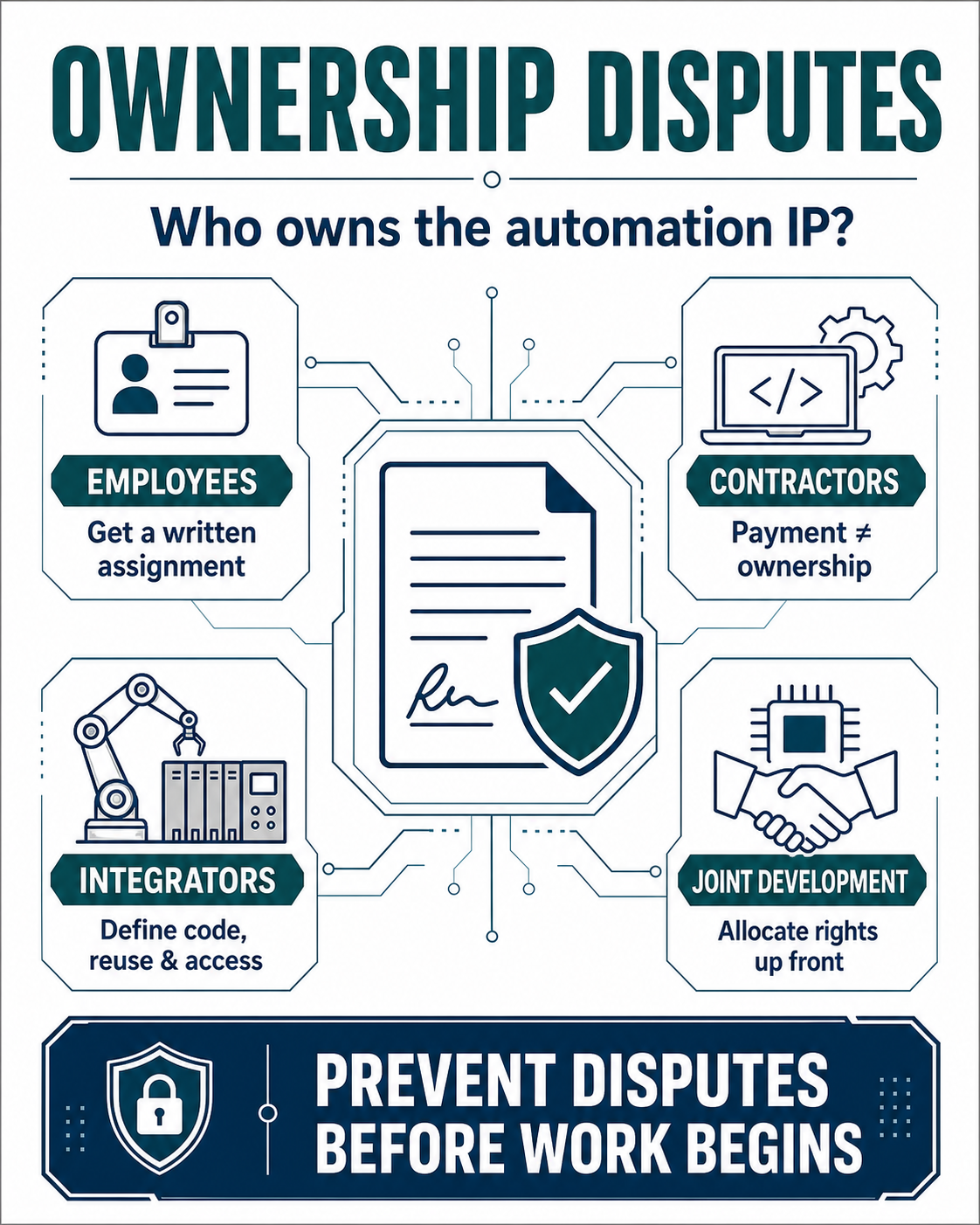
Ownership Disputes Involving Employees, Contractors, and Integrators
This is where automation companies get hurt most often, and it is almost always preventable with paperwork that costs a fraction of the litigation it avoids.
Employees
In the United States, an invention is initially owned by the inventor, not the employer. Employment alone does not automatically transfer patent rights. Without a written assignment, an employer may be left arguing equitable doctrines such as hired to invent or shop rights, both of which are narrower and far less reliable than a signed agreement. Assignment language also matters: agreements that say an employee “hereby assigns” future inventions are treated very differently from ones that say the employee “agrees to assign.”
Contractors and Contract Engineers
Independent contractors own what they create unless they have signed a written assignment. This surprises people constantly. For software and firmware, the copyright work made for hire doctrine generally does not apply to independent contractors, so a contractor who writes your HMI application or controller code may own that copyright even after you have paid the invoice in full.
System Integrators and Machine Builders
Integrator relationships are the single most common source of automation ownership disputes we see. Who owns the PLC program written specifically for your line? Can the integrator reuse that logic for your direct competitor next quarter? Do you get the source code, or only a compiled download? What happens when the integrator goes out of business? These questions belong in the contract before the project starts, not in a lawyer’s office after the line is running.
Joint Development and Vendor Collaboration
Co-development with a customer or component supplier creates joint inventorship risk. Under U.S. patent law, each joint owner can generally exploit and license the patent without the other’s consent and without accounting for profits. A clear allocation of rights up front prevents your development partner from licensing your shared technology to the competitor you were trying to beat. We handle these arrangements through intellectual property license agreements and development contracts drafted for the realities of industrial work.
Software and Firmware Protection in Industrial Systems
Automation runs on code, and that code may sit at the intersection of three different forms of intellectual property protection. Copyright protects the original expression embodied in computer code, but generally does not protect the underlying algorithms, processes, systems, or methods of operation. Patents extend to the functionality implemented by the software. Trade secret law can protect source code, algorithms, configuration data, and other nonpublic technical information as long as the company takes reasonable measures to protect it. The right strategy often uses these protections together rather than treating them as alternatives.
Two issues deserve specific attention. First, patent eligibility for software claims depends heavily on how the claims are drafted, and claims tied to a concrete technical improvement in the operation of a machine or process are generally on stronger ground than abstract data manipulation. See our discussion of software patent protection for background. Second, open source components carry license obligations, and copyleft licenses embedded in shipped firmware can create disclosure obligations that undermine the secrecy of everything around them. Our cyber law practice addresses code licensing, data rights, and the digital side of industrial systems.
Confidentiality During Plant Visits, Demonstrations, and Proposals
Automation companies leak intellectual property through completely ordinary business activity. The sales process itself is the exposure.
Plant tours put visitors in front of proprietary tooling, line layouts, and process equipment. Live demonstrations show competitors exactly what your system does and often how it does it. Detailed proposals and RFQ responses frequently contain the technical approach that is your actual differentiator. Vendor and supplier discussions require sharing specifications and tolerances that reveal how you achieve performance others cannot match.
Practical safeguards are straightforward. Execute a written confidentiality agreement before any technical discussion, not after. Limit proposals to what performance the system delivers rather than the mechanism that achieves it. Restrict photography and control tour routes. Mark drawings and documents. Log who received what and when, because that record is what proves misappropriation later. Confirm that your patent filings are on record before any public demonstration.
Industries and Technologies We Serve
We work with industrial and technology companies including machine builders and OEMs, sensor and instrumentation developers, controls and systems integrators, packaging and material handling equipment manufacturers, agricultural and precision farming technology firms, medical device and life science instrumentation makers, robotics and motion control companies, process control and analytics providers, and industrial IoT and connected equipment developers.
How We Work With Automation and Manufacturing Clients
Most engagements start with an intellectual property audit that maps what your company actually owns, what is protectable, where the ownership gaps are, and what is currently exposed. From there we build a protection strategy that assigns each asset to the right mechanism, put the necessary agreements in place with employees, contractors, and integrators, prepare and prosecute patent applications, and stand behind the portfolio through intellectual property litigation when enforcement becomes necessary. For companies raising capital, being acquired, or licensing technology, we also handle intellectual property valuation.
Frequently Asked Questions
Who owns the PLC code an integrator wrote for our production line?
Unless your contract says otherwise, the integrator very likely does. Copyright in software belongs to the party that created it, and the work made for hire doctrine generally does not transfer ownership from an independent contractor without a signed written agreement. Paying for the work is not the same as owning it. That means the integrator may be free to reuse the same control logic on a competitor’s line. The fix is a written agreement executed before the project begins that assigns ownership, or at minimum grants you a perpetual license, delivers source code, and restricts reuse within your industry. If a line is already running under a silent contract, the ownership question can often still be resolved through a negotiated amendment.
Should we patent our control algorithm or keep it a trade secret?
The deciding factor is whether a competitor could figure it out on their own. Patents require public disclosure in exchange for twenty years of exclusivity, so patenting something invisible inside a control cabinet publishes a roadmap that nobody could otherwise obtain. Trade secret protection lasts indefinitely and costs far less, but it offers no defense against independent development or legitimate reverse engineering. As a general rule, algorithms that leave no observable trace in the product favor trade secret treatment, while anything a customer or competitor could measure, disassemble, or infer from the system’s behavior favors a patent. Many automation companies use both, patenting the hardware and system architecture while holding calibration data and tuning parameters as secrets.
Our engineer left for a competitor. What can we actually do?
Move quickly, because delay undercuts both the legal remedies and the credibility of the claim. Start by preserving evidence: badge and system access logs, file transfer and email records, repository activity, and the departing employee’s devices, before anything is wiped or reissued. Identify precisely what confidential information that person had access to and document why it qualifies as a trade secret. Then review what they signed, including confidentiality, assignment, and any non-solicitation or non-competition provisions, keeping in mind that enforceability of restrictive covenants varies significantly by state. Remedies under the federal Defend Trade Secrets Act and state trade secret statutes can include injunctive relief and damages, and in serious cases courts have ordered the return or destruction of misappropriated materials. What determines the outcome, more than anything else, is whether you can show you treated the information as secret before it walked out the door.
Protect Your Automation Technology Before It Walks Out the Door
Ownership problems in industrial technology are cheap to prevent and expensive to fix. If you are launching a new sensor or control product, bringing on an integrator, hiring controls engineers, preparing for a trade show, or entering a joint development arrangement, the right time to address intellectual property is now.
The Intellectual Property Center serves manufacturers and technology companies throughout Kansas City, Missouri, Kansas, and the broader Midwest. Schedule a consultation or call (816) 363-1555 to discuss your automation and sensor technology.
This page provides general information and does not constitute legal advice. Every situation is different, and intellectual property rights depend on specific facts and applicable law.
Software and Firmware Protection in Industrial Systems
Automation runs on code, and that code may sit at the intersection of three different forms of intellectual property protection. Copyright protects the original expression embodied in computer code, but generally does not protect the underlying algorithms, processes, systems, or methods of operation. Patents can extend to them and protect the functionality implemented by the software. Trade secret law protects source code, algorithms, configuration data, and other nonpublic technical information as long as the company takes reasonable measures to keep it a secret. The right strategy often uses these protections together rather than treating them as alternatives..
Two issues deserve specific attention. First, patent eligibility for software claims depends heavily on how the claims are drafted, and claims tied to a concrete technical improvement in the operation of a machine or process are generally on stronger ground than abstract data manipulation. See our discussion of software patent protection for background. Second, open source components carry license obligations, and copyleft licenses embedded in shipped firmware can create disclosure obligations that undermine the secrecy of everything around them. Our cyber law practice addresses code licensing, data rights, and the digital side of industrial systems.
Confidentiality During Plant Visits, Demonstrations, and Proposals
Automation companies leak intellectual property through completely ordinary business activity. The sales process itself is the exposure.
Plant tours put visitors in front of proprietary tooling, line layouts, and process equipment. Live demonstrations show competitors exactly what your system does and often how it does it. Detailed proposals and RFQ responses frequently contain the technical approach that is your actual differentiator. Vendor and supplier discussions require sharing specifications and tolerances that reveal how you achieve performance others cannot match.
Practical safeguards are straightforward. Execute a written confidentiality agreement before any technical discussion, not after. Limit proposals to what performance the system delivers rather than the mechanism that achieves it. Restrict photography and control tour routes. Mark drawings and documents. Log who received what and when, because that record is what proves misappropriation later. Confirm that your patent filings are on record before any public demonstration.
Industries and Technologies We Serve
We work with industrial and technology companies including machine builders and OEMs, sensor and instrumentation developers, controls and systems integrators, packaging and material handling equipment manufacturers, agricultural and precision farming technology firms, medical device and life science instrumentation makers, robotics and motion control companies, process control and analytics providers, and industrial IoT and connected equipment developers.
How We Work With Automation and Manufacturing Clients
Most engagements start with an intellectual property audit that maps what your company actually owns, what is protectable, where the ownership gaps are, and what is currently exposed. From there we build a protection strategy that assigns each asset to the right mechanism, put the necessary agreements in place with employees, contractors, and integrators, prepare and prosecute patent applications, and stand behind the portfolio through intellectual property litigation when enforcement becomes necessary. For companies raising capital, being acquired, or licensing technology, we also handle intellectual property valuation.
Frequently Asked Questions
Who owns the PLC code an integrator wrote for our production line?
Unless your contract says otherwise, the integrator very likely does. Copyright in software belongs to the party that created it, and the work made for hire doctrine generally does not transfer ownership from an independent contractor without a signed written agreement. Paying for the work is not the same as owning it. That means the integrator may be free to reuse the same control logic on a competitor’s line. The fix is a written agreement executed before the project begins that assigns ownership, or at minimum grants you a perpetual license, delivers source code, and restricts reuse within your industry. If a line is already running under a silent contract, the ownership question can often still be resolved through a negotiated amendment.
Should we patent our control algorithm or keep it a trade secret?
The deciding factor is whether a competitor could figure it out on their own. Patents require public disclosure in exchange for twenty years of exclusivity, so patenting something invisible inside a control cabinet publishes a roadmap that nobody could otherwise obtain. Trade secret protection lasts indefinitely and costs far less, but it offers no defense against independent development or legitimate reverse engineering. As a general rule, algorithms that leave no observable trace in the product favor trade secret treatment, while anything a customer or competitor could measure, disassemble, or infer from the system’s behavior favors a patent. Many automation companies use both, patenting the hardware and system architecture while holding calibration data and tuning parameters as secrets.
Our engineer left for a competitor. What can we actually do?
Move quickly, because delay undercuts both the legal remedies and the credibility of the claim. Start by preserving evidence: badge and system access logs, file transfer and email records, repository activity, and the departing employee’s devices, before anything is wiped or reissued. Identify precisely what confidential information that person had access to and document why it qualifies as a trade secret. Then review what they signed, including confidentiality, assignment, and any non-solicitation or non-competition provisions, keeping in mind that enforceability of restrictive covenants varies significantly by state. Remedies under the federal Defend Trade Secrets Act and state trade secret statutes can include injunctive relief and damages, and in serious cases courts have ordered the return or destruction of misappropriated materials. What determines the outcome, more than anything else, is whether you can show you treated the information as secret before it walked out the door.
Protect Your Automation Technology Before It Walks Out the Door
Ownership problems in industrial technology are cheap to prevent and expensive to fix. If you are launching a new sensor or control product, bringing on an integrator, hiring controls engineers, preparing for a trade show, or entering a joint development arrangement, the right time to address intellectual property is now.
The Intellectual Property Center serves manufacturers and technology companies throughout Kansas City, Missouri, Kansas, and the broader Midwest. Schedule a consultation or call (816) 363-1555 to discuss your automation and sensor technology.
This page provides general information and does not constitute legal advice. Every situation is different, and intellectual property rights depend on specific facts and applicable law.