



7-Eleven Nike Trademark Dispute: Colors, Patterns and Dilution
Most people recognize 7-Eleven before they read the sign.
Orange, green and red stripes.
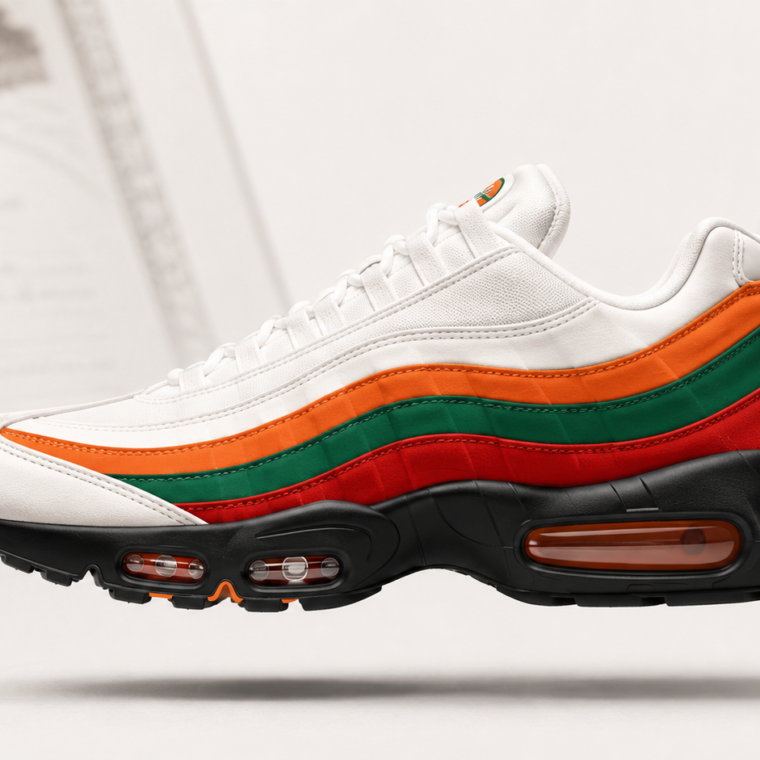
That color pattern is now at the center of the 7-Eleven Nike trademark dispute between 7-Eleven and Nike.
On July 1, 2026, 7-Eleven filed suit against Nike in the United States District Court for the Northern District of Texas over a Nike Air Max 95. According to the complaint, Nike’s shoe uses a color pattern that comes too close to 7-Eleven’s orange, green, and red stripe brand.
7-Eleven’s claims that Nike’s use of a similar arragement of those colors on a show creates confusion and Infringes its Trademark rights.
The release date for the shoe, added another layer. Nike scheduled the shoe to launch on July 11 or 7/11.
For 7-Eleven, the date is part of their brand narrative. Nike’s use of the color combination, the stripe pattern, and the July 11 release date was intended to assocaite the show with the 7-Eleven brand without permission. Third-party media coverage and product listings also described the shoe as tied to, inspired by, or associated with 7-Eleven.
At this stage, we only have 7-Eleven’s side of the story. But the lawsuit raises a useful question for brand owners, designers, and marketing teams:
When does a color pattern stop being decoration and start functioning as a trademark?
7-Eleven Says It Owns a Distinctive Color Pattern
7-Eleven is not relying only on its name or logo.
The company claims rights in a distrinctive tri-color pattern that contrubutes to the overall look and feel of the 7-Eleven brand. 7-Eleven has used orange, green, and red as part of its brand for nearly sixty years and, according to the lawsuit, a distinctive orange, green, and red stripe pattern since at least 1987.
7-Eleven trademark rights focus on the particular stripe pattern, not merely the three colors in the abstract. According to 7-11, the tri-color stripe pattern is unique and recognized by consumers as an indication of the source of its products and retail-store services. The stripe pattern also appears as part of several of 7-Eleven’s federally registered trademarks.
A color or color pattern often begins as a decorative design choice, and consumers may initially view it as ornamentation rather than as a trademark. Over time, however, a consistently used arrangement of colors may become protectable when it is nonfunctional and consumers come to recognize it as identifying a single commercial source. In that circumstance, trademark or trade dress protection may extend to the particular arrangement and placement of the colors as used on the company’s products, packaging, or other branding materials.
7-Eleven is essentially saying: these colors are not just a color scheme. They are our brand identity.
The July Date Strengthens the 7-Eleven Nike Trademark Claim
The sneaker’s colors, viewed alone, may be explained as a design choice. The surrounding circumstances, however, make that explanation less persuasive. According to 7-Eleven, the use of orange, green, and red, combined with a launch scheduled for July 11, created a deliberate association with the 7-Eleven brand.
Trademark disputes often turn on context rather than on any single design element. Here, the shoe’s color arrangement, launch date, marketing, media coverage, and marketplace reaction may collectively support the argument that consumers would associate the sneaker with 7-Eleven. Third-party product listings reportedly referred to it as the “7-Eleven” shoe, while media outlets described the design as inspired by the convenience-store brand.
Intent is not required to establish trademark infringement, but evidence that a company deliberately sought to evoke another brand can strengthen an infringement claim. Because trademark law focuses on likely consumer perception, evidence that consumers, retailers, or commentators immediately connected the sneaker with 7-Eleven supports the argument that the design was intended to and created a misleading commercial association.
Collaborations Have Changed How Consumers Read Brands
One of the more modern aspects of the complaint is 7-Eleven’s discussion of brand collaborations.
7-Eleven has collaborated with brands such as Crocs, Sunday Golf, Breezy Golf, and DGK. Consumers are now used to seeing the branding elements on footwear, clothing, and accessories. Althought the complaint does not mention it, there appears to have been some collaborative history between 7-11 and Nike. One sneaker publication reported that 7-Eleven and Nike planned a footwear project in 2020 that was never released.
These collaborations reflect the increasingly flexible boundaries of modern branding. A convenience store may collaborate with a footwear company, a restaurant may sell apparel, and a snack brand may appear on a pair of shoes. In that environment, a distinctive color pattern can signal an association with a brand even without a brand name or logo.
As a result, consumers who recognize 7-Eleven’s orange, green, and red color scheme may assume that a similarly designed product is licensed, sponsored, or approved by the company. For marketing teams, that recognition presents both an opportunity and a risk. The purpose of a brand-inspired design is often to make consumers recognize the reference, while trademark law asks whether that recognition is likely to create confusion regarding sponsorship, affiliation, or approval.
The 7-Eleven Nike Trademark Claim Is About Association
7-Eleven’s infringement theory is built around consumer association.
The complaint alleges that Nike’s shoe is likely to make consumers believe the product is manufactured, authorized, licensed, sponsored, endorsed, or approved by 7-Eleven.
That is the core Lanham Act issue.
The question is whether the accused use is likely to confuse consumers about source, sponsorship, affiliation, or approval.
If 7-Eleven supports these allegations with sufficient evidence, a court may find that Nike crossed the line from inspiration into infringement.
The Dilution Claim Is About Keeping the Brand Strong
7-Eleven also brings dilution claims.
Trademark dilution is different from ordinary trademark infringement. It protects famous marks from use that weaken their distinctiveness, even without proof of likely consumer confusion.
7-Eleven’s dilution theory is that its orange, green, and red stripe pattern is famous and uniquely associated with 7-Eleven. If another company can use a similar color pattern on unrelated products the pattern may become less exclusive to 7-Eleven.
Put more simply, the mark gets watered down by repeated unauthorized use.
That is why the complaint emphasized fame. To prevail on a federal dilution claim, 7-Eleven must establish that its mark is widely recognized by the general consuming public. The complaint highlights decades of use, thousands of stores, substantial sales and advertising, federal registrations, media recognition, and consumer association as evidence of the mark’s alleged fame and goodwill.
Lessons for Brand Owners
The lesson for brand owners is straightforward. If your company has a distinctive look, treat it as a business asset.
That look may include a color combination, stripe pattern, packaging format, product presentation, logo placement, store design, website layout, trade dress, or a combination of visual elements.
To protect that asset, a company should be able to identify what makes the look distinctive. It should use that look consistently. It should document the use. It should register protectable elements where possible. It should control licensing and collaborations. And it should police unauthorized uses.
A style guide is not just a marketing document. In the right case, it can become evidence of brand identity.
Brand consistency can become leverage.
The more consistently a company uses its distinctive visual identity, the easier it becomes to show that consumers recognize it as a brand and not just decoration.
Lessons for Product Designers and Marketing Teams
The case also carries a warning for companies launching new products.
A design team may think it is being clever.
A marketing team may think it is creating buzz.
A launch team may think the timing is fun.
But if the product depends on consumers recognizing another brand, the trademark risk should be reviewed before launch.
Before moving forward with a brand-inspired product, companies should ask practical questions:
- Will consumers recognize the reference?
- Is the other brand famous?
- Does that brand license or collaborate in this product category?
- Are we using a color pattern, launch date, packaging style, or promotional message that strengthens the association?
- Would media outlets likely describe our product by naming the other brand?
If the marketing value comes from another company’s brand identity, legal review should happen before the product goes public.
Why the 7-Eleven Nike Trademark Case Is Worth Watching
The 7-Eleven Nike Trademark case is a modern brand dispute.
It is about color, timing, consumer perception, collaborations, and the commercial value of being recognized without using a name.
That is why the case is important to all brand owners.
Strong brands are often built from repeated visual cues. A company spends years teaching customers to recognize a color pattern, package style, store design, or product look. When that happens, the look itself may become protectable.
For brand owners, remember to protect the visual cues customers recognize.
For product-development teams, remember that colors, visual designs, packaging, recurring promotional dates, marketing campaigns, and marketplace reaction may collectively create a recognizable brand association.
How The IP Center Can Help
The IP Center helps businesses protect and enforce trademarks, trade dress, brand identity, product names, logos, slogans, packaging, and other intellectual property rights.
For brand owners, that may include trademark clearance, federal trademark applications, trade dress strategy, brand-protection programs, enforcement letters, settlement strategy, TTAB proceedings, and trademark litigation.
For companies preparing to launch a product, it may include reviewing names, logos, color schemes, packaging, product designs, marketing campaigns, collaboration concepts, and promotional timing before the product goes public.
Strong brands are built with consistency over time.
Trademark problems can happen quickly.
Before adopting a product design, brand reference, color scheme, or marketing campaign that can create an association with another company, you should seek trademark advice early.
Need help with a trademark dispute, product launch, or brand-clearance issue? Contact The IP Center.