

How to Patent an Invention: Step-by-Step Guide to the Patent Application Process
To patent an invention in the United States, you document the invention, confirm it is patentable through a prior art search, prepare an application that describes and claims it, file that application with the U.S. Patent and Trademark Office, respond to the examiner’s rejections during a process called prosecution, and pay an issue fee when the application is allowed. The process typically takes two to three years and costs between $3,000 and $15,000 in combined government and attorney fees for a straightforward invention.
The most common way inventors lose patent rights is by doding something, like showign the product at a trade show or posting it online (or submitting it to an AI platform), before filing for patent protection.
This guide walks through how to get a patent and how to file a patent application, including what it costs, how long it takes, and what inventors most often do to hurt their chances of obtaining a patent. If you would rather discuss your specific invention, our Kansas City patent attorneys have prepared more than 400 U.S. patents across software, mechanical, electrical, medical device, and manufacturing technologies. We have published guidance on the U.S patent process since 2004 and provided updated informaiton as the law has evolved.
What Can and Cannot Be Patented
A patent is an property right granted by the federal government whcih allows you to exclusde others. In exchange for publicly disclosing how your invention works, you receive the right to stop others from making, using, selling, offering to sell, or importing it for a set term. A patent does not by itself give you the right to seel your own product. If your product uses technoogy covered by somene else’a patent, you may still need a license. That separate question is called freedom to operate and often relates to another legal concept called patent infringement.
The Four Requirements for a Patent
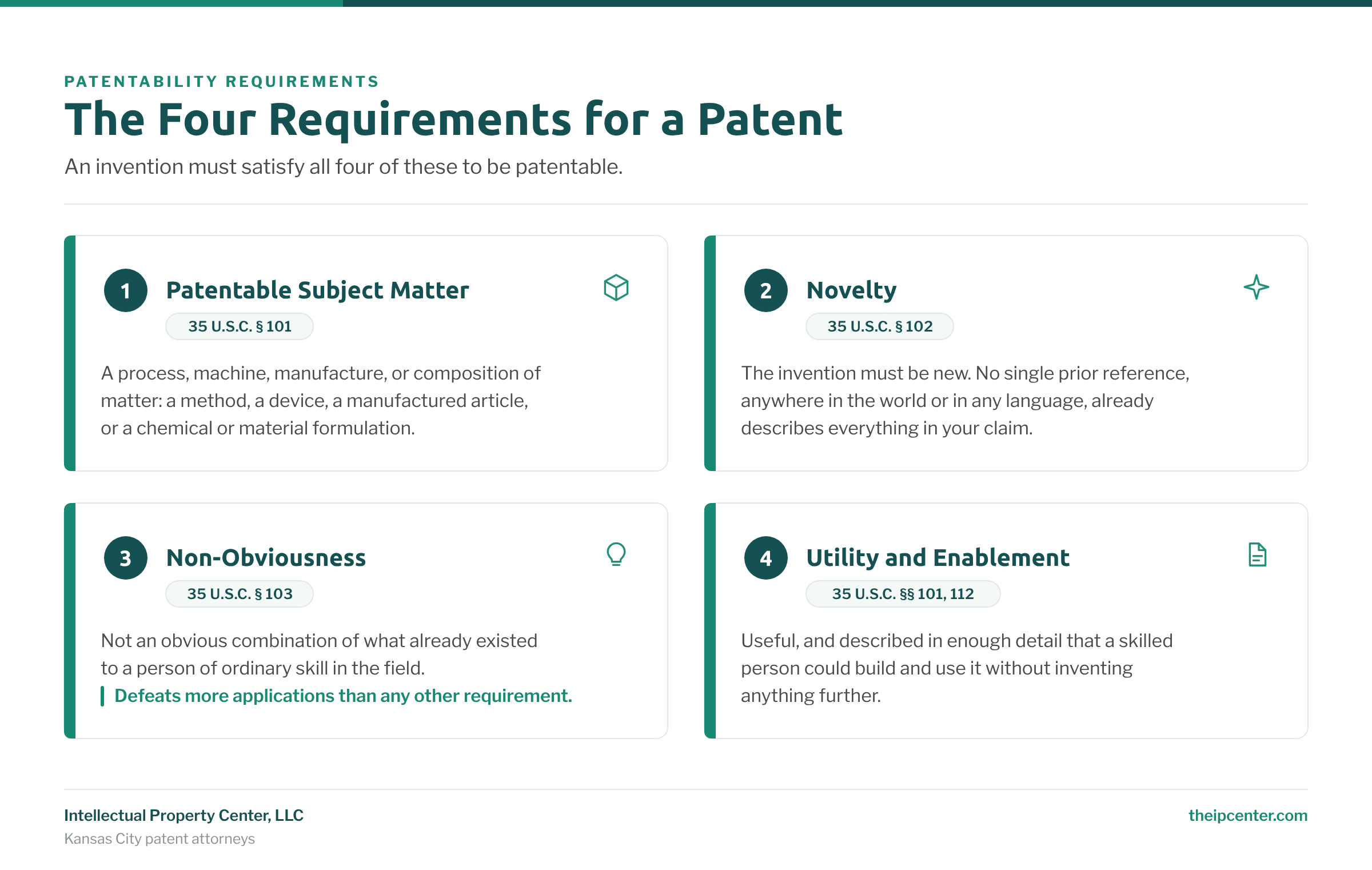
An invention must satisfy all four of these to be patentable.
- Patentable subject matter. Under 35 U.S.C. 101, a patent may cover a process, machine, manufacture, or composition of matter. In practice, this means a method, a device, a manufactured article, or a chemical or material formulation.
- Novelty. The invention must be new. If a single prior reference, anywhere in the world and in any language, already describes everything in your claim, the claim is anticipated and cannot be patented.
- Non-obviousness. Even if no single reference describes your invention, it cannot be an obvious combination of what already existed to a person of ordinary skill in the field. This is the requirement that defeats the largest number of applications.
- Utility and enabeling disclosure. The invention must be useful. Most inventions meet the utility rquirmeent easily, though it can be an issue for speculative chemical compounds or devices that claim to defy known science. In addition, your application must describe it in enough detail that a skilled person could build and use it without undue experimentation of their own. In addition, the application must show that you possess the claimed invention when you file the application, and use clear claims to inform others wha the scope of your invention is so that they can avoid it. The application must also disclose the best way known to carry out the invention, although since 2011 failing to do is not a basis to invalidate the patent.
How Obviousness is Determined
Novelty is measured by looking at one reference at a time. However, Obviousness can be measured against multiple references. The examiner can combine several references, but they must give a reason a person skilled in the relevant art would have combined them. The examiner can not just provide a listing of them and say your invention is obvious. The rationale follows the Supreme Court’s framework in the 1966 Supreme Court case Graham v. John Deere Company of Kansas City. In Graham, the court said that obviousness requires a determination of the scope of the prior art, an identification of the differences between it and the claims at issue, and the level of ordinary skill in the relevant field. Evidence such as commercial success, a long-felt but unsolved need, the failure of others, unexpected results, and copying by competitors can help show that an invention was not obvious.
What Cannot Be Patented
Courts have carved out judicial exceptions for abstract ideas, laws of nature, and natural phenomena. You cannot patent a mathematical formula, a scientific principle, a naturally occurring substance in its natural state, or a purely mental process. You also cannot patent an idea in the loose sense of the word. There is no such thing as patenting a concept you have not yet worked out. The invention has to be reduced to something concrete and describable.
This line is hardest to draw for software and data-driven inventions, where eligibility turns heavily on how the claims are written and whether they are tied to a concrete technical improvement rather than an abstract result. USPTO guidance issued in late 2025 has made that path clearer for AI and machine learning inventions. Our discussion of software patents covers that distinction in more depth.
Three Types of Patents
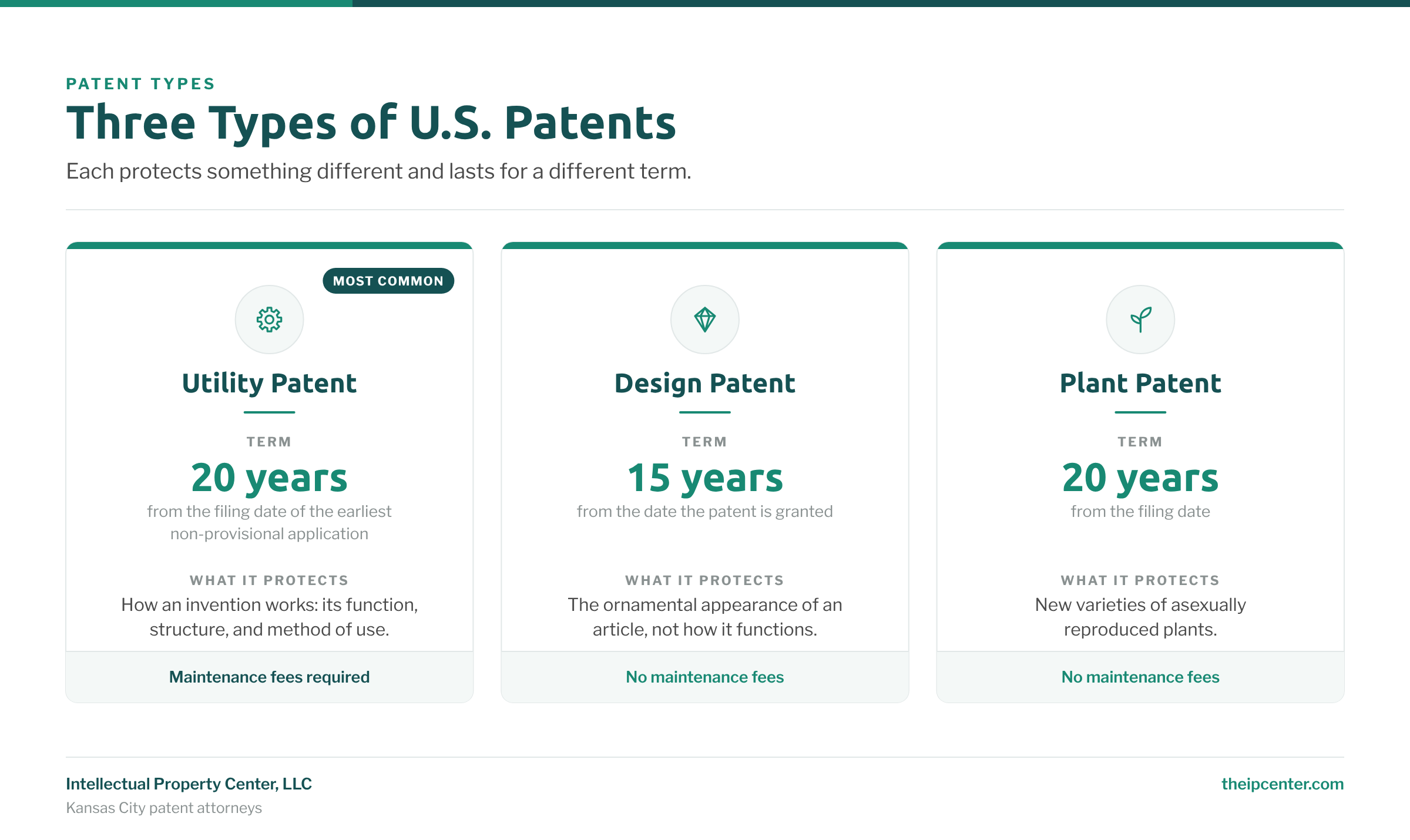
- A utility patent protects how an invention works and lasts 20 years from the filing date of the earliest non-provisional application, adjsuted for certain USPTO delays and subject to payment of patent maintenance fees. This is what most people mean by a patent.
- A design patent protects the ornamental appearance of an article rather than its function, and lasts 15 years from the date it is granted. Design patents require no maintenance fees.
- A plant patent protects new varieties of asexually reproduced plants and lasts 20 years from filing.
Many products warrant both a utility and a design patent, because the two protect different things. A competitor who redesigns around your function may still infringe your appearance, and the reverse is equally true.
Step 1: Document the Invention and Establish a Record
Before anything is filed, write down what you built, how it works, when you conceived it, and when it first worked. Date the entries, keep the drawings and test data, and note everyone who contributed. Before you share your invention with anyone outside your company, such as a manufacturer, investor or designer, have them sign a nondisclosure agreement.
The United States has operated on a first-inventor-to-file system since the America Invents Act took effect on March 16, 2013, so your records no longer win a priority race against another inventor the way they once did. Good records still help in four ways: establishing who the correct inventors are, which is a legal requirement and a common source of later invalidity attacks; proving what you had before a disclosure or a collaboration; giving your attorney the technical foundation to draft meaningful claims, and supporting a derivation proceeding if someoen files on an invention which was learned based on your disclosure to them.
One warning here. The widely repeated advice to mail yourself a description of your invention, sometimes called a poor man’s patent, provides no legal protection whatsoever. It does not create rights, and it does not preserve a filing date.
Step 2: Search the Prior Art
A prior art search tells you whether your invention is already known, and it is the cheapest point in the entire process to find out that it is.
Searching covers issued patents, published patent applications, and non-patent literature including products, catalogs, academic papers, and websites. The USPTO’s Patent Public Search tool is free and open to anyone, and Google Patents and Espacenet are useful starting points.
A free self-search is worth doing, but it is not the same as a professional search. Patent classification systems, claim language conventions, and foreign-language references are difficult to navigate without experience, and the references that kill an application are usually the ones an inventor would never think to look for. A professional patent search with an attorney opinion typically costs a fraction of a full application and can save the entire investment.
A search produces one of three answers: the field is clear enough to proceed, the invention needs to be narrowed to something new, or the space is already occupied and you should redirect your resources. Any of these three is worth knowing before you make the decision to hire an attorney to assist in filing a patent application.
Step 3: Decide Whether a Patent Is the Right Tool
Patents are not always the correct answer, and a good patent attorney will tell you when they are not.
A patent requires public disclosure. Eighteen months after your earliest priority date, your application publishes, and the world can read exactly how your invention works. In return, you get the right to exclude others for up to twenty years from the filing. If you do not plan to file outside the U.S., there may be benefits to filign the application with a non publication request.
Trade secret protection is the opposite. You disclose nothing, the protection lasts indefinitely, and the cost is far less, but you have no recourse against someone who independently develops the same thing or lawfully reverse engineers your product.
The practical test is whether a competitor could figure it out from your product. If your invention is visible in the field, a patent is the only thing standing between you and a copy. If it is invisible in operation, such as a manufacturing process, a formulation, or control logic inside a locked enclosure, publishing it in a patent may hand away the exact advantage you were trying to keep.
Deciding early how you plan to make money from your invention can also guide your decision to file a patent, including whether you plan to sell it yourself, license it to others, or sell the rights to the invention outright. Your answer shapes how much protection is worth investing in and where it might be best to pursue.
Note also that patents, trademarks, and copyrights protect different things. A patent covers how your invention works. A trademark covers the brand name under which it is sold. A copyright covers creative expression such as code, manuals, and marketing materials. Most products need more than one.
Step 4: Choose Your Filing Path
The One-Year Deadline That Ends Patent Rights
Under 35 U.S.C. 102, you generally have one year from the first public disclosure, public use, offer for sale, or sale of your invention to file a U.S. patent application. Miss that window and your right to patent is gone permanently. The grace period protects you from your own disclsoures. it does not fuilly protect you if someone else independently publishes or files an application on the same invention in the meantime, so attempting to wait out the year is risky.
Disclosures that start the clock often seem harmless, like:
- Attending a trade show
- A Kickstarter campaign
- A sales quote or purchase order, even a confidential one that says nothing about how the invention works
- A presentation at a conference
- A website product page
- A pilot installation at a customer site
- A social media post showing the prototype
Many other countries, including Europe and China, are stricter. They require absolute novelty, meaning any public disclosure before filing can destroy foreign rights immediately. A few, such as Canada, Japan, South Korea and Australia, allow a limited grace period with conditions. If you want patent protection outside the U.S., consider filing before disclosure.
Provisional Patent Application
A provisional patent application establishes a filing date, lets you use the term patent pending, and gives you twelve months to file a complete non-provisional application claiming its priority.
A provisional is never examined and never becomes a patent on its own. If you do not file a non-provisional within twelve months, it expires, and the priority date disappears. The twelve months are also not added to your patent term, which runs from the non-provisional filing date.
Provisionals are useful for buying time to test the market, raise capital, or finish development. They are also frequently misused. A provisional is only as good as what it describes, so a thin two-page filing that omits the feature you later want to claim will not support that claim. The disclosure requirement is the same as for a full application.
Non-Provisional Patent Application
The non-provisional application is the real filing. The USPTO examines it, and it can become an enforceable patent. For many inventors, especially those who have already disclosed the invention or who need enforceable rights quickly, filing a non-provisional directly is the better choice.
Step 5: Prepare the Application (Patent Filing Requirements)
A patent application is a technical and legal document with required components.
- The specification describes the invention in full: its field, the problem it solves, and a detailed account of how to make and use it, usually including alternatives and variations. Anything not described here cannot be claimed later. Statements in the background section about the prior art can later be used against you.
- The claims define the legal boundaries of your protection. They are the most important part of the document. Claims that are too narrow are easy to design around; claims that are too broad are rejected or later invalidated. Claim drafting is the core skill a patent attorney brings, and it is the part that most reliably separates a patent that holds up from one that looks impressive and protects nothing.
- The drawings must show every feature recited in the claims and follow specific USPTO formatting rules.
- The supporting papers include an inventor’s oath or declaration, an application data sheet, an entity status certification, and an information disclosure statement listing the prior art you are aware of. That last one reflects a continuing duty of candor to the USPTO under 37 CFR 1.56, and violating it can render a patent unenforceable.
You file applications electronically through Patent Center, the USPTO’s current filing system.
Step 6: File With the USPTO and Pay the Fees
USPTO fees depend on your entity size. Small entities, generally individuals, universities, nonprofits, and businesses with 500 or fewer employees (counting affiliates) that are not obligated to assign or license the invention to a larger company receive a 60 percent discount. Micro entities, which must meet the small entity requirements plus a gross income cap set at three times the median household income and a limit of four previously filed applications, receive an 80 percent discount. Certifying the wrong status has consequences, so confirm it before filing.
The amounts below reflect the USPTO fee schedule effective January 19, 2025, as last revised November 1, 2026. These change often and must be verified before filing. These fees below do not reflect the fees associated with hiring a patent attorney to prepare or file the relevant document(s).
| Fee | Undiscounted | Small entity | Micro entity |
|---|---|---|---|
| Provisional application | $325 | $130 | $65 |
| Utility basic filing | $350 | $140 | $70 |
| Utility search | $770 | $308 | $154 |
| Utility examination | $880 | $352 | $176 |
| Utility filing total | $2,000 | $800 | $400 |
| Design filing, search, and exam | $1,300 | $520 | $260 |
| Each independent claim over three | $600 | $240 | $120 |
| Each claim over twenty | $200 | $80 | $40 |
| Utility issue fee | $1,290 | $516 | $258 |
| Design Issue Fee | $1,300 | $520 | $260 |
| Maintenance fee at 3.5 years | $2,150 | $860 | $430 |
| Maintenance fee at 7.5 years | $4,040 | $1,616 | $808 |
| Maintenance fee at 11.5 years | $8,280 | $3,312 | $1,656 |
| Track One prioritized examination | $4,515 | $1,806 | $903 |
Two fee categories added in 2025 are worth planning around. Continuing applications filed more than six years after the earliest non-provisional parent carry a $2,700 surcharge, rising to $4,000 after nine years. Information disclosure statements also now carry size fees once cumulative references pass 50, 100, and 200.
Step 7: Respond to the Examiner
Filing is the beginning, not the end. The examination phase, called prosecution, is where most of the work happens.
The USPTO assigns your application to an examiner in the relevant technology area. The examiner searches the prior art and issues an office action, which is usually a rejection. Receiving a first-action rejection is normal. Most applications that are eventually granted receive at least one rejection.
After receiving an office action, you then respond, typically by amending the claims, by arguing that the examiner misread the references, or both. Generally, an office action has to be responded to within three (3) months. This exchange may repeat. If you reach a final rejection and still want to continue, you can file a request for continued examination, which costs $1,500 undiscounted for the first and $2,860 for the second and later ones (less for small and micro entities). If the examiner is not persuaded, you can appeal to the Patent Trial and Appeal Board.
When the examiner is satisfied, you receive a notice of allowance, pay the issue fee, and the patent grants. If you may want more claims later, for example to cover a competitor’s design, you should discuss filing a continuation application with your attorney prior to the issuance of the patent. Once the application (or some related application) is no longer pending, that option is lost. After the patent issues, review it for errors; most can be fixed with a certificate of correction.
How Long Does It Take to Get a Patent?
Expect roughly two to three years, though it varies widely by technology.
USPTO data for fiscal year 2026 puts average first office action pendency at 20.5 months, down from 22.6 months at the end of fiscal 2025. Average total pendency, from filing to issuance or abandonment, was about 28.8 months as of September 2026. The agency ended fiscal 2026 with 745,074 unexamined applications on hand, down from 788,229 a year earlier.
Crowded fields such as software and telecommunications run longer. Mechanical and simpler technologies often move faster.
If you need speed, Track One prioritized examination targets a final disposition within about twelve months for an additional fee of $4,515 undiscounted. It is often worth it when a product launch, a funding round, or an infringer is driving the timeline.
How Much Does It Cost to Patent an Invention?
Total cost has two components: USPTO fees, which are fixed and published, and professional fees, which depend on complexity.
For a typical mechanical or consumer product invention, inventors commonly spend $8,000 to $15,000 from filing through issuance when working with counsel. Complex software, electronics, biotechnology, and medical device applications more often run $15,000 to $30,000 or higher, largely because the specifications are longer and prosecution takes more rounds. Provisional applications prepared properly generally run a few thousand dollars. Maintenance fees then come due at 3.5, 7.5, and 11.5 years, totaling $14,470 undiscounted over the life of a utility patent.
Cost is also a function of decisions. A professional search that redirects you away from an occupied field saves far more than it costs. Claims drafted well the first time shorten prosecution. For companies weighing that spend against the asset being created, patent valuation can help frame the decision in business terms. Ask any attorney you speak with for a written estimate that separates government fees from professional fees, and that states what is included.
Protecting Your Invention Outside the United States
Patents are territorial. A U.S. patent gives you no rights in Germany, China, or Canada.
Two mechanisms preserve your options. Under the Paris Convention, you have twelve months from your first filing to file in other member countries while keeping your original priority date. A Patent Cooperation Treaty application extends that, generally giving you 30 months from your earliest priority date to decide which individual countries to enter. The PCT does not grant an international patent, because no such thing exists. It buys time and defers cost while you explore if there is demand for your invention outside the U.S.
If your invention was invented in the U.S., you may need a foreign filing license prior to filing abroad. A U.S. application usually receves one, but filing abroad without first obtaining a one can result with a loss of your patent rights and in some cases, civil or criminal penalities.
Common Mistakes That May Cost Inventors Their Patent Rights
- Disclosing before filing. The one-year U.S. bar and absolute novelty abroad are the leading causes of permanently lost rights.
- Providing unfiled invention details into a public AI tool. Disclosing confidential information into an AI platform may count as a public disclosure.
- Filing a thin provisional. A placeholder that does not describe what you later want to claim will not support that claim.
- Naming inventors incorrectly. Inventorship is a legal determination based on contribution to the claims, not a matter of courtesy, seniority, or funding. Getting it wrong is a basis for invalidating a patent. Only people can be named as inventors. If AI tools are used to develop the invention, the USPTO applies the same inventorship test it uses for any invention.
- Assuming employment transfers ownership. In the United States, an invention is initially owned by the inventor. Without a written assignment, an employer may hold nothing. Contractors own what they create unless they have signed one.
- Skipping the search. Discovering, readily discoverable prior art which rejects the patent only after spending on the full application is avoidable and expensive.
- Paying an invention promotion company. Firms that charge large up-front fees to evaluate or market an idea rarely deliver. Federal law requires them to disclose how many of their clients have made money, and the USPTO publishes complaints against them.
- Treating the patent as the goal. A patent is an enforcement tool. Its value shows up in license agreements, in valuations, in investor diligence, and in patent litigation if it comes to that. Claims should be drafted with those uses in mind from the start.
Do You Need a Patent Attorney?
Legally, no. You may file and prosecute your own application, and the USPTO provides resources for inventors who do.
Practically, the decision depends on what the patent is for. If you want an enforceable asset, claim drafting is the skill that determines whether you get one. Only attorneys and agents registered with the USPTO may represent applicants before it, and a patent with claims that competitors can easily design around is worse than no patent at all, because it costs money and provides a false sense of security.
Frequently Asked Questions
Can I patent an idea?
No. You cannot patent an idea in the abstract. Patent law requires an invention that has been developed far enough that you can describe how to make and use it, in enough detail that a skilled person in the field could build it without inventing anything further. A concept for a product, without a worked-out structure or method behind it, is not patentable no matter how commercially promising it is. You do not need a working prototype, which surprises many inventors, but you do need a complete technical description. If you are early, a provisional application can establish a filing date while you continue development, provided the provisional itself fully describes what you eventually want to claim. Before spending on a patent, decide how you plan to make money from the invention, since that shapes how much protection is worth buying.
How long does it take to get a patent?
Most applications take two to three years from filing to issuance. Track One prioritized examination can shorten that to about a year for an additional fee. Current USPTO figures are in the section above about the current Patent backlog.
How much does it cost to patent an invention?
USPTO fees to file a non-provisional utility application total $2,000 undiscounted, $730 for small entities filing electronically, and $400 for micro entities, plus an issue fee of $1,290, $516, or $258, respectively. Attorney fees are the larger variable. A straightforward mechanical or consumer product typically runs $3,000 to $15,000 through issuance, while software, electronics, and medical device applications more often fall between $15,000 and $30,000.
What is the difference between a provisional and a non-provisional patent application?
A provisional application establishes a filing date and allows you to use the term patent pending, but it is never examined and cannot become a patent. It expires after twelve months, and you must file a non-provisional within that window to keep the priority date. A non-provisional application is the one the USPTO examines and the one that can issue as an enforceable patent. Provisionals help buy time to develop, test, or raise money at a lower initial cost, but the disclosure standard is the same, so a thin provisional will not support claims it never described.
Do I lose my patent rights if I already sold or showed my invention?
Not necessarily, but you are on a clock. U.S. law generally gives you one year from the first public disclosure, public use, offer for sale, or sale to file an application. File within that year and your rights are intact. Miss it, and they are permanently gone. Foreign rights are a different matter, because most countries require absolute novelty and may already be lost as of your first public disclosure. If you have shown, sold, or published anything related to your invention, treat the filing date as urgent and talk to a patent attorney about exactly when the clock started.
Start Your Patent Application
If you have an invention you are considering patenting, the two biggest decisions are whether to file at all and how soon. Both are easier to make with an informed read on the prior art and a clear view of the deadlines that apply to your situation.
The Intellectual Property Center serves inventors, startups, and manufacturers in Kansas City, throughout Missouri and Kansas, and nationwide. Schedule a consultation or call (816) 363-1555 to discuss your invention.
This page provides general information about U.S. patent law and does not constitute legal advice. Patent rights depend on specific facts, deadlines, and applicable law. USPTO fees and pendency figures are current as of November 2026 and are subject to change.